Overview & First Impressions
The journey commenced at Tokyo's Haneda Airport (HND), where the Japan Airlines (JAL) 'The Red Lounge' provided a distinct and culturally rich pre-flight experience. The lounge stood out with its clear representation of Japanese culture, immediately recognizable upon entry. A particular highlight for aviation enthusiasts was a dedicated 'avgeek' corner, featuring a detailed flight instrument panel, complete with gear controls and autopilot panels, alongside a rich display of the airline's history. This thoughtful touch, a rarity among airline lounges, was highly appreciated. Furthermore, The Red Lounge boasted a game room adorned with aeronautical charts, blending style with aviation passion.
Culinary offerings in the lounge were equally impressive. Beyond interesting vegetable dishes that resembled fish, the famous Japanese curry rice lived up to its reputation, noted for its beautiful aroma and taste. A quiet corner on the fifth floor offered stunning views, making it an ideal spot to relax. The recommendation to arrive early to fully enjoy the lounge's amenities, food, and views was well-founded.
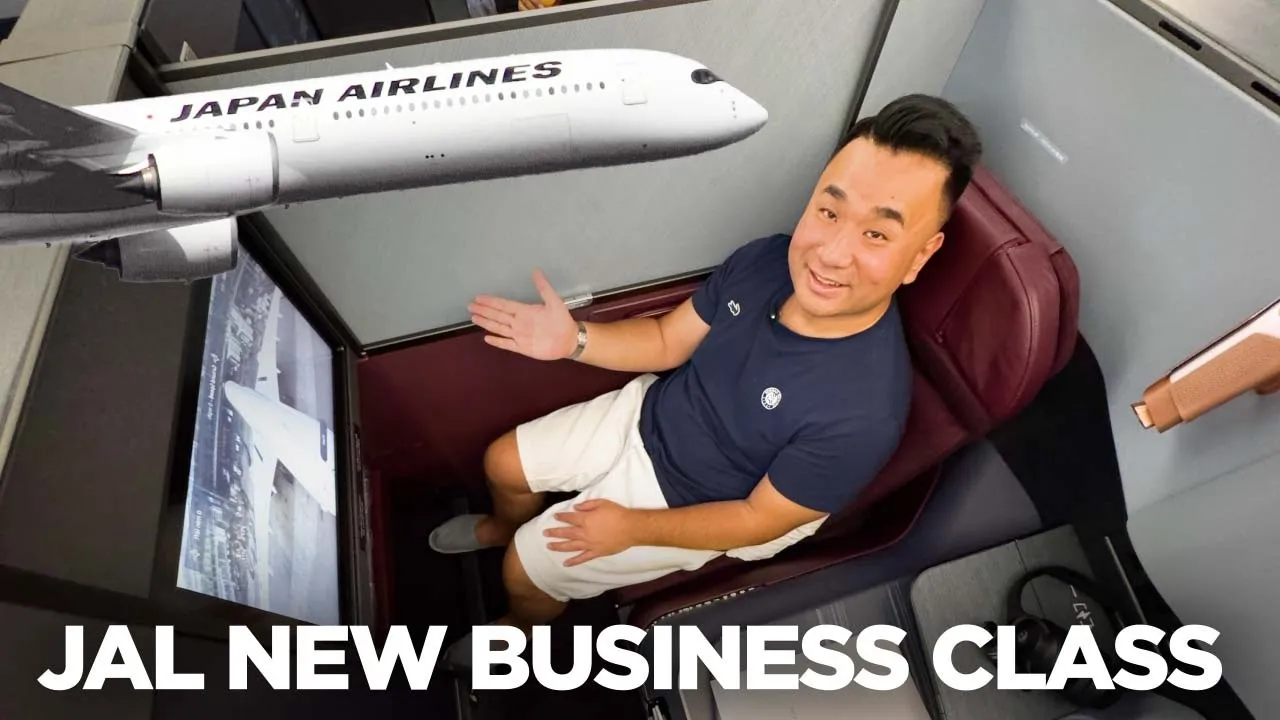
Boarding for JAL flight JL16 to Los Angeles (LAX) on the flagship A350-1000 was a seamless transition from the lounge experience. The aircraft, a relatively new addition to JAL's fleet, exuded a 'new car smell' upon entry, a testament to its recent delivery. Having witnessed the first aircraft delivery in Toulouse, there was an added anticipation for this flight, undertaken for a business trip to the APEX Summit in Los Angeles. Upon being welcomed aboard and guided to the middle suite, the initial impression of the Business Class cabin was one of profound privacy. While the enclosed nature, surrounded by walls and cubicles, felt 'a bit weird' at first, the immediate sense of personal space quickly became appealing, offering a completely private environment where 'nobody gets to see you.'
Seat, Cabin & IFE
The Japan Airlines A350-1000 Business Class middle suite is designed with an emphasis on personal space and privacy, offering a cubicle-like environment that ensures a completely private experience. The seat itself, while initially feeling enclosed, quickly becomes a personal sanctuary. It features ample storage options, including dedicated compartments for cameras, smartphones, coats, and even shoes, ensuring that personal belongings are neatly stowed and easily accessible. The dining table is ingeniously designed to 'come around' to the passenger, enhancing convenience during meal service.
For rest, the seat transforms into a lie-flat bed that is notably 'long enough' for taller passengers, including the reviewer at 185 cm (6 ft). The footwell, while described as 'okay,' allows for some movement. A unique and appreciated service feature was the flight attendant's offer to set up the bed, including a choice between a 'hard mattress' or 'soft mattress,' thanks to a clever two-in-one mattress design. Despite the generous length, the reviewer found the bed 'a little bit narrow' and experienced a less-than-optimal sleep quality on the overnight flight, which had lights off for only about three hours. This suggests that while the product is strong, individual comfort preferences may vary.
The In-Flight Entertainment (IFE) system incorporates cool technology, most notably a 'wireless speaker' built into the headrest, eliminating the immediate need for traditional headphones. Passengers can also pair their own Bluetooth speakers or use provided headphones. However, a design quirk meant that leaning forward to eat caused a loss of sound from the headrest speaker, making headphones advisable during meals. The IFE content itself was noted as having 'quite limited choice.' Power outlets for charging devices were conveniently available at the seat. In comparison to ANA's Business Class, both airlines offer full privacy cubicles. JAL's product is characterized by a wider footwell allowing 'forward' sleeping, whereas ANA offers more shoulder room but a narrower footwell that necessitates sleeping diagonally. Both Japanese carriers are commended for maintaining high standards, distinguishing them from other Asian competitors who have reduced service quality post-pandemic.
Food, Drinks & Service
Upon boarding, passengers were offered a choice of orange juice or champagne as a welcome drink, with champagne being the selected refreshment. An innovative aspect of the in-flight service was the ability to 'borrow a cardigan' through the IFE screen, an order that was impressively fulfilled within ten minutes. This on-demand galley service, allowing passengers to order items directly from the screen for delivery, was highlighted as a 'next gen' service experience. The cardigan, once received, provided extra warmth, enhancing comfort in the cabin.
Despite these high-tech service innovations, there were notable delays in traditional food and drink service. It took over an hour after takeoff for initial drinks and food to be served, and the main course arrived almost three hours into the flight. This significant delay was a point of concern, especially for a business traveler needing to maximize productivity on a nine-hour overnight flight across the Pacific. The extensive size of JAL's Business Class cabin, spanning two zones with the reviewer seated in the rear, was suggested as a potential factor contributing to the slower service rollout.
The meal options included a Japanese 'Washoku' menu featuring fish and curry rice, and a Western menu with beef filet or salmon. The Washoku option was chosen, and the appetizer course was highly praised for its quality and variety, offering a rich selection of flavors including seafood, beef, chicken, salmon, and crab meat. The main course, which eventually arrived, consisted of beef, chicken curry, fish, miso soup, and rice. It was described as tasting 'pretty good' and was consumed quickly, leading to the decision to skip dessert due to time constraints. Despite the service delays, the cabin crew received 'kudos' for their attentiveness in other areas, particularly for promptly assisting with the bed setup and offering a choice of mattress firmness, demonstrating a commitment to passenger comfort.