Overview & First Impressions
The journey to experience Surinam Airways began with a flight to Paramaribo, Suririnam, via Copa Airlines with a brief overnight stop in Panama. Suririnam, a small nation in northern South America, recently gained independence from the Netherlands in 1975 and is largely covered by rainforest. While the stay in Paramaribo was short, the local hospitality left a positive impression, hinting at a vibrant culture worth exploring further.
Upon arrival at the airport, it was clear that this facility handles a limited number of daily flights, primarily serving Copa Airlines to Panama, a KM flight to Amsterdam, and Surinam Airways, which operates four times a week to Amsterdam. The check-in process was straightforward, and an upgrade to Business Class for the 10-hour flight was available for $500 USD, a decision deemed worthwhile for the extended travel time.
The airport featured a single, general lounge for all Business Class passengers, which became quite crowded as flights from KM, Copa Airlines, and Surinam Airways often departed concurrently. Despite the crowds, the lounge offered a decent experience, providing a hot buffet and a selection of alcoholic beverages. However, a notable inconvenience was the non-functional power outlets and USB ports at the gates, a minor but frustrating detail for business travelers needing to charge devices.
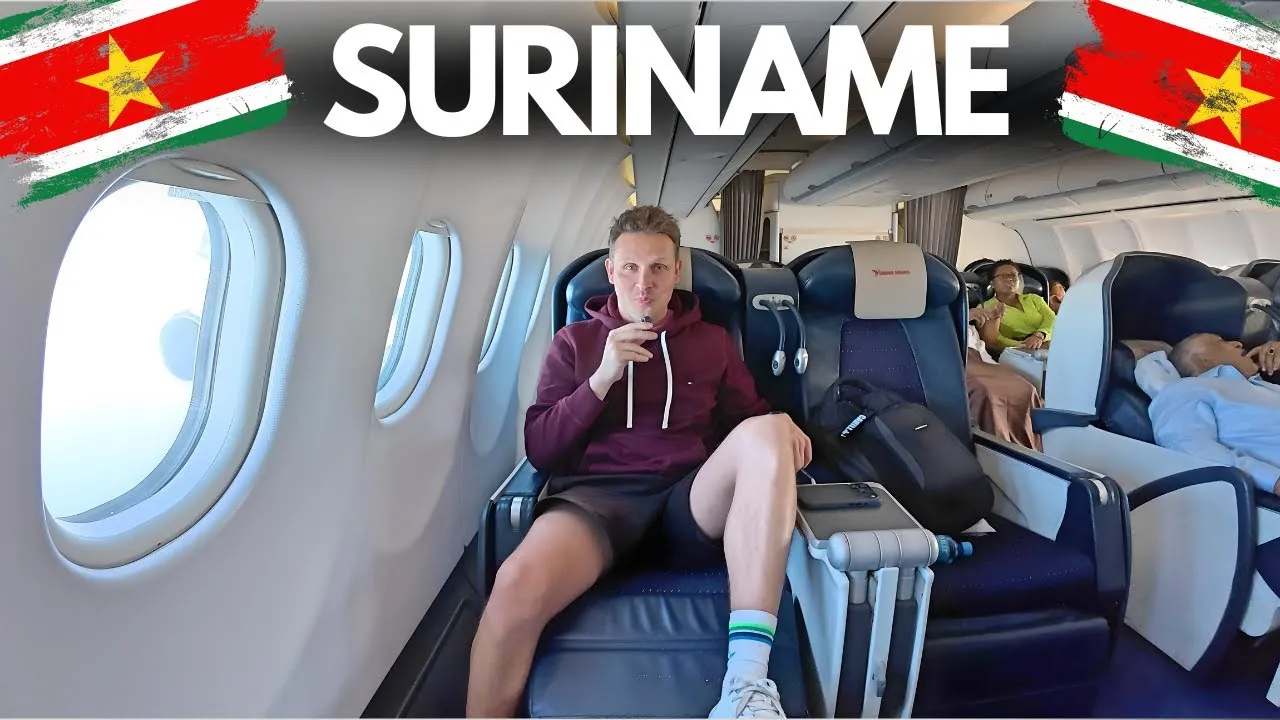
The aircraft for this long-haul segment was an unmarked Airbus A340-600, operated by Universal Sky Carrier, a German charter airline. This particular plane, 22 years old, had a history of service with South African Airways. Boarding involved an unusual walk to the aircraft, offering a unique perspective of the Airbus A340-600, a beautiful and historically significant wide-body jet, once the longest passenger plane in the world. Initial impressions of the cabin revealed a spacious Business Class, configured in a 2-2-2 layout, with a generally welcoming atmosphere from the crew, despite an unusual incident with the German pilot who expressed discomfort with filming onboard. The crew, however, handled the situation professionally, ensuring a pleasant start to the flight.
Seat, Cabin & IFE
The aircraft for this journey was an Airbus A340-600, a 22-year-old wide-body jet that previously flew for South African Airways. The Business Class cabin presented a spacious, forward-facing configuration with a 2-2-2 layout, accommodating a significant number of premium passengers. While the overall cabin aesthetic reflected the aircraft's age, it maintained a functional and relatively well-kept appearance.
The seat itself offered adequate legroom, which was a positive aspect for a long-haul flight. Each seat was equipped with an amenity kit, a pillow, and a small blanket. However, the blanket provided was notably thin, more akin to what one might expect in an Economy Class cabin, and offered limited comfort for an overnight flight. A minor privacy divider was available between seats, providing a modest separation from the adjacent passenger.
Functionality of the seat proved to be a mixed experience. While a massage function was present and operational, its effect was barely discernible. More critically, the recline mechanism for the lie-flat bed function on the reviewed seat was unfortunately broken, rendering it unusable. Attempts to utilize the "cradle" option also met with limited success. This significantly impacted the ability to rest comfortably during the extensive flight duration. Fortunately, an adjacent seat was found to be fully functional in its recline, though the comfort level even in a fully reclined position was described as "extremely uncomfortable," making a full night's sleep challenging.
In-flight entertainment (IFE) details were not extensively covered, suggesting a potentially older or limited system, consistent with the aircraft's age. Power outlets and USB ports were not explicitly mentioned as available or functional at the seat, which is a key consideration for business travelers. The general lounge prior to boarding did offer power outlets, but these were found to be non-functional, highlighting a potential area for improvement in ground services.
Food, Drinks & Service
The culinary experience on Surinam Airways was a delightful highlight, particularly due to the airline's commitment to offering local flavors. Upon boarding, passengers were offered a choice of orange or apple juice as a pre-departure beverage. A comprehensive menu and wine list were distributed shortly after take-off, setting expectations for the meal service.
For dinner, the crew enthusiastically recommended the local chicken dish, known as Pome paste. This traditional Surinamese delicacy, originally a Jewish dish adapted in Suririnam with root vegetables instead of potatoes, featured chicken stewed in a rich tomato sauce. Served with rice and a starter, the dish was described as "really delicious" with "very nice flavors," a strong recommendation for those seeking an authentic taste of Suririnam. The dinner service also included a local dessert resembling a cinnamon roll, generously filled with raisins and cinnamon, which was equally well-received and deemed "very delicious."
Breakfast service, served as the flight approached its destination, comprised a traditional omelette accompanied by potatoes, a fresh croissant, a selection of fruits, yogurt, and coffee. While specific details on its taste were brief, it provided a satisfying and familiar start to the day.
Beyond the food, the service from the Surinam Airways crew was truly exceptional and stood out as the most commendable aspect of the flight. From the moment of boarding, the crew exuded "amazing hospitality" and were consistently described as "absolutely fantastic." Their attentiveness was evident in their proactive recommendations for local dishes and their genuine engagement with passengers. A particularly notable instance of their professionalism and warmth was their handling of a difficult situation with the German pilot, who expressed strong disapproval of filming onboard. The lead cabin crew member approached the matter with remarkable tact and friendliness, mediating the pilot's concerns without being aggressive, and ultimately ensuring a positive experience for the passenger. This approach, characterized by understanding and a willingness to find common ground, was deeply appreciated and reflected the crew's dedication to passenger satisfaction. Their friendly demeanor and eagerness to connect, even sharing personal stories, significantly enhanced the overall journey, transforming what could have been a standard flight into a truly memorable experience.